
Healthy Meal Service DC
-
Trusted healthy meal service provider with over 35 years of experience in Washington, D.C.
When employees leave the building to find a quality meal, the cost extends well beyond the time spent away from their desks. Productivity gaps, schedule disruptions, and missed opportunities for meaningful interaction between colleagues represent a daily expense that most organizations never quantify. Monumental Markets has delivered healthy meal service in D.C. to offices, government facilities, and commercial properties since 1991, placing fresh and nutritious food directly inside the workplaces that need it. We partner with organizations of all sizes throughout the District, and every program we build reflects the dietary preferences, spatial constraints, and operational demands of the workforce it serves. Contact us to schedule a consultation.
-

Healthy Meal Service in Washington, D.C.
A healthy meal service places fresh, ready-to-eat meals directly inside the workplace on a consistent schedule. Employees are not choosing between a bag of chips from a vending machine and a 20-minute trip to the nearest fast-casual chain. They have real food available in the building, portioned properly, sourced from local and regional suppliers, and rotated regularly to keep the menu from going stale.
In a city like Washington, D.C., where the average lunch outing can easily consume 45 minutes between walking, waiting, and commuting back, an in-office meal program reclaims a significant portion of the workday for every employee who uses it.
Types of Healthy Meal Services We Provide in Washington, D.C.
The right meal service depends on the size of your team, the layout of your space, and what your employees actually want. A 40-person nonprofit on K Street operates differently from a 200-person government contractor in Southwest. We account for those differences. Below are the core services available through our healthy meal service program in D.C.
- Fresh Prepared Meals. Salads, grain bowls, wraps, and sandwiches made daily and delivered to your office. Every item is individually packaged for grab-and-go convenience. We rotate the menu weekly, so employees are not eating the same three options every Tuesday.
- Healthy Snack Programs. Protein bars, fresh fruit, yogurt, hummus cups, nuts, and other nutrient-dense snacks are stocked alongside the meal program. Healthy options sit right next to traditional favorites, so the choice is always there without removing what people already enjoy.
- Fresh Fruit Delivery. Whole fruit delivered on a recurring schedule. Apples, bananas, oranges, and seasonal selections are placed in common areas where employees can grab them throughout the day. It sounds simple, but it is one of the most consistently used items in any office food program.
- Breakfast Service. Overnight oats, breakfast sandwiches, pastries, and fruit cups are available before the workday begins. For offices where early arrivals are the norm, having something ready at 7:00 a.m. changes how the morning unfolds.
- Coffee and Beverage Integration. A healthy meal service works best when it includes a full beverage program. We offer specialty coffees, teas, cold brew, sparkling water, and juices alongside the food. The office coffee service runs as part of the same account, so there is only one vendor to manage.
- Dietary-Inclusive Menus. Plant-based, gluten-free, dairy-free, halal, kosher, and allergen-conscious options are stocked at the same level of variety as everything else. We do not treat these as special requests. They are part of the standard program from day one.
- Micro Markets. For larger offices, the meal service can be housed inside a full micro market with open shelving, commercial coolers, and self-checkout kiosks. This gives employees a retail experience without leaving the building and without requiring any staffing from your side.
- Office pantry services. Some D.C. employers cover the full cost of office food as a benefit. Our pantry service handles inventory, restocking, and product rotation on a set schedule. You set the budget, and we manage everything within it.
-
-
Why Choose Monumental Markets for Healthy Meal Service in Washington, DC?
Built for the District
We are not a national franchise operating out of a regional warehouse. Monumental Markets was built in this market, and we have operated across Washington, D.C., Maryland, and Virginia for over 35 years. That longevity is not incidental. It means we have worked inside the security protocols of federal buildings, navigated the loading dock logistics of downtown D.C. high-rises, and adapted to the scheduling realities of offices that run from 6:00 a.m. to midnight.
Our clients include Comcast, Microsoft, Capital One, Leidos, Northrop Grumman, JBG SMITH, the USDA, and the D.C. government. We understand that a healthy meal provider in the District needs more than good food. It needs operational reliability in a city where building access, delivery windows, and compliance requirements are not negotiable.
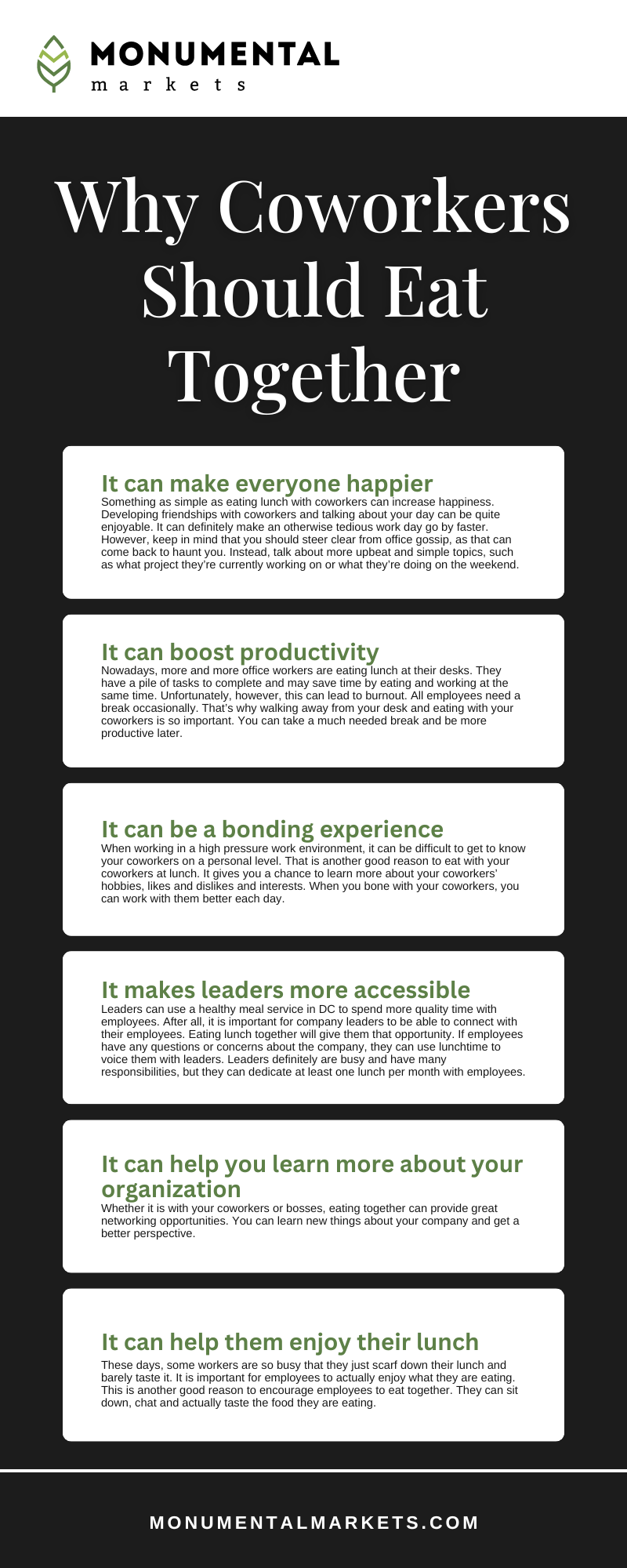
DC Healthy Meal Service Infographic
Understanding Healthy Meal Service Programs for the Workplace
Why Workplace Nutrition Matters More Than Most Employers Realize
The food available inside an office shapes how employees perform for the rest of the day. The CDC’s workplace health program identifies nutrition as one of the key modifiable health risks affecting productivity, absenteeism, and long-term health care costs. Poor nutrition at work does not just lead to afternoon fatigue. Over time, it contributes to chronic conditions that drive up insurance premiums and reduce workforce stability.
A properly run healthy meal service in D.C. addresses several of these risk factors at once:
- Employees eat more balanced meals when nutritious options are placed within reach, a principle the CDC’s food service guidelines specifically recommend for worksite food environments
- Mid-afternoon productivity loss decreases when lunch consists of whole foods rather than calorie-dense, low-nutrient alternatives
- Retention improves when employees feel their employer invests in their day-to-day well-being, not just annual benefits
- Cross-departmental interaction increases around shared food spaces, which improves workplace morale and strengthens team cohesion
- Alignment with the USDA’s Dietary Guidelines for Americans becomes practical rather than aspirational when nutrient-dense options are available daily
Research published through the National Institutes of Health has consistently found that workplaces offering health promotion programs, including on-site nutrition, see measurable gains in employee outcomes and organizational performance.
Key Factors in Choosing a Healthy Meal Service
Selecting a provider is not just about the menu. Several operational factors determine whether a healthy meal service will succeed in your office or become another underused perk.
Freshness protocols are the first thing to evaluate. Ask how frequently the provider restocks, whether items carry clearly printed sell-by dates, and how unsold food is handled at the end of each cycle. A service that lets products sit for days is not a healthy meal service in any meaningful sense. Payment infrastructure also matters. Cashless systems that accept tap-to-pay, mobile wallets, and standard cards reduce friction at the point of purchase. If paying is inconvenient, usage drops regardless of how good the food is.
Equally important is whether the provider can accommodate the common myths about meal services that lead employers to over-customize or under-invest. The right provider will guide you through what actually works based on data, not guesswork.
What a Typical Setup Timeline Looks Like
Most healthy meal service installations in Washington, D.C. follow a similar sequence, though timelines shift depending on building requirements and the scope of the program.
- A site visit and consultation come first, typically completed within one to two weeks of initial contact
- Product selection and menu curation happen in parallel, informed by employee demographics, dietary preferences, and budget parameters
- Equipment installation, including coolers, display units, and payment kiosks, takes three to five business days in most D.C. office environments
- A two-week pilot period allows for adjustments based on actual usage patterns before the program moves into full operation
- Ongoing service includes scheduled restocking, equipment maintenance, and quarterly reviews of what is working and where the menu should shift
The requirements on your end are minimal—dedicated floor space, a standard electrical outlet, and a reliable internet connection. We manage the rest, from supply chain logistics to daily midday meal fulfillment.
What to Prepare Before Your Initial Consultation
A few details gathered in advance help us recommend the right program faster.
- The number of employees who will have regular access to the service
- Any dietary requirements or restrictions that are common across your team
- Available space for the installation, including square footage and proximity to break rooms or common areas
- Whether the program will be employer-subsidized, employee-paid, or a hybrid of both
- Any building-specific access or delivery constraints, which are common in downtown D.C. commercial properties
We walk through each of these during the consultation. Most offices are fully operational within 30 days.
Washington, D.C. Resources for Workplace Food Programs
For D.C. employers exploring workplace nutrition programs or food service compliance, the following resources offer a strong foundation.
- The CDC’s healthy food environments page provides federal strategies for improving food access in worksite and community settings
- DC Health’s Division of Food oversees food safety inspections and licensing for food service operations within the District of Columbia
- The CDC’s food service guidelines outline nutrition standards for food sold or served in worksites, including vending, micro markets, and cafeteria environments
- DC Health food safety regulations contain the municipal code requirements for any food service or establishment operating in Washington, D.C.
- The USDA Dietary Guidelines for Americans, 2025-2030, set the federal nutritional framework for healthy eating and can inform workplace food program standards
These are useful starting points for any employer considering a formal meal service or evaluating the compliance requirements of an existing program.
Contact Monumental Markets to Schedule a Consultation
Monumental Markets has spent over three decades helping D.C. offices bring healthy food that fits into the workday. From a single-floor healthy meal service to a multi-building food program, we build around your workforce and your space. Contact us today to schedule a free consultation and see what a better break room looks like for your team.